
Coinbase v. Illinois: The Hearing That Could Shape the Future of Prediction Markets
February 25, 2026
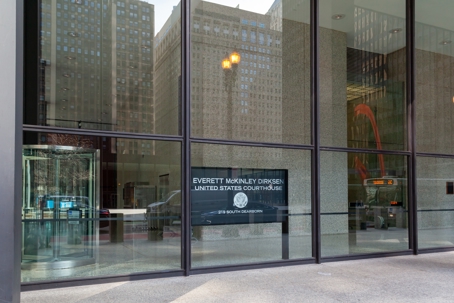
On Tuesday, a federal courtroom in Chicago became the latest battleground in what may be the most consequential regulatory fight in financial markets today: whether sports-related event contracts are federally regulated derivatives or state-regulated gambling.
In Coinbase Financial Markets, Inc. v. Raoul, No. 1:25-cv-15406, U.S. District Judge Martha Pacold heard oral arguments on Coinbase's motion for a preliminary injunction to block Illinois from enforcing its gaming laws against the company's planned prediction market offerings. The hearing crystallized the competing arguments that have now divided federal courts across the country. It also raised hard questions that neither side can easily dismiss.
Here is what happened, why it matters, and where this fight is heading.
The Dispute
Coinbase announced in December 2025 that it would partner with KalshiEX LLC, a CFTC-registered designated contract market, to offer event contracts through Coinbase's platform. These are binary instruments, structured as yes-or-no questions, that pay out based on whether a specified event occurs. They cover everything from Federal Reserve rate decisions to weather patterns to, critically, sports outcomes.
Illinois hit back fast. The state pointed to cease-and-desist letters the Illinois Gaming Board had already sent to Kalshi, Robinhood, and Crypto.com in April 2025, warning that offering sports-related event contracts without a state gaming license constitutes illegal gambling under the Illinois Sports Wagering Act and the Illinois Criminal Code. By October, the Board had expanded its threats to all licensees and stakeholders in the state.
Coinbase filed suit in December, along with parallel actions in Connecticut and Michigan, seeking to enjoin Illinois from applying its gambling laws to federally regulated event contracts.
The Core Legal Question: Swap or Wager?
The entire case turns on a deceptively simple question. Are sports-related event contracts "swaps" under the Commodity Exchange Act?
If yes, the CEA grants the CFTC "exclusive jurisdiction" over these transactions when traded on designated contract markets, and state gambling laws are preempted. If no, the CFTC has no claim to these products, and states are free to regulate or prohibit them under traditional police powers.
Coinbase's argument rests on the CEA's broad definition of "swap," which covers any contract providing for a payment "dependent on the occurrence, nonoccurrence, or the extent of the occurrence of an event or contingency associated with a potential financial, economic, or commercial consequence." Coinbase argues sports-related event contracts fit this definition squarely. Sporting events carry enormous economic consequences. College playoff games can make or break local economies. NFL teams are attracting private equity investment. Broadcasting deals are worth billions.
Counsel for Coinbase, Yaira Dubin of Sullivan & Cromwell, told the court that the question is not whether these products should be regulated, but who should regulate them. "The only question here is who is the proper regulator of these nationwide markets," she said, "the federal government or 50 different states?"
Illinois's argument attacks the "swap" classification at its foundation. Assistant Attorney General Darren Kinkead drew a distinction between an "event" and an "outcome," arguing that the CEA's swap definition covers contracts dependent on whether an event occurs, not on who wins. His example landed well: when the judge eventually rules on this motion, nobody will call the winning party to congratulate them on a great "event."
Illinois also pushed back on the "financial consequence" prong. Athletic competitions, the state argued, are not inherently financial, economic, or commercial in nature. The downstream economic effects Coinbase cites (tourism, broadcasting revenue, investment returns) are too attenuated. If those indirect effects suffice, there would be no limiting principle. Virtually any human activity has economic ripple effects. The swap definition would swallow all of gambling.
Judge Pacold's Pointed Questions
Judge Pacold's questioning suggested she is wrestling seriously with both sides. Two lines of inquiry stood out.
First, she pressed Coinbase on the breadth of its "swap" definition, asking how it would avoid sweeping in all forms of gambling. This is the strongest version of Illinois's argument. If a bet on whether the Bears win the Super Bowl is a "swap," why isn't a bet placed at a Las Vegas sportsbook? Dubin responded that state law is preserved for transactions that do not ordinarily occur on designated contract markets, and emphasized the structural differences. Prediction markets are neutral exchanges matching buyers and sellers. Sportsbooks set odds and bet against their own customers. The two products may offer similar economic exposure, but they are built on entirely different foundations.
Second, the judge questioned whether it was truly impossible for Coinbase to comply with both state and federal law, which is the standard for impossibility-based conflict preemption. She noted that other businesses, like retailers, navigate overlapping state and federal regulatory requirements every day. Dubin's answer was direct: the federal "impartial access" requirement for designated contract markets is fundamentally incompatible with state-by-state geographic restrictions on who can trade.
The "No Regulation" Argument
Perhaps the most politically potent moment came from Kinkead. He urged the court to consider the practical reality behind Coinbase's preference for CFTC oversight. The agency, he argued, has been hollowed out. No enforcement lawyers remain in the CFTC's Chicago office. Only one commissioner sits on a body designed for five.
"Really, this is not a choice between CFTC regulation and state regulation," Kinkead said. "It's a choice between Illinois regulation and no regulation at all."
This argument does not resolve the statutory interpretation question. But it reframes the policy stakes considerably. If the CFTC lacks the resources or political will to actively police these markets, preempting state authority could leave consumers without meaningful protection, including safeguards against gambling addiction, bans on betting on high school sports, and other measures Illinois has enacted.
A Nationwide Split Getting Wider
The Illinois hearing takes place against a backdrop of rapidly multiplying, and deeply conflicting, court decisions nationwide.
In New Jersey, a federal judge granted Kalshi a preliminary injunction in April 2025, finding its sports event contracts fall within the CFTC's exclusive jurisdiction. That decision is now on appeal to the Third Circuit.
Nevada's trajectory has been more turbulent. A federal judge initially granted Kalshi an injunction in April 2025, then dissolved it in November, holding that sports contracts turn on "outcomes" rather than "events." The case is on appeal to the Ninth Circuit, with consolidated oral arguments expected in April 2026.
Maryland denied Kalshi's injunction in August 2025, concluding that Congress did not clearly intend to strip states of authority over gambling. The Fourth Circuit now has the appeal, and 36 states have filed amicus briefs in support of state authority.
In Massachusetts, a state court granted an injunction against Kalshi in January 2026, rejecting its preemption argument as "overly broad." That ruling has been stayed pending appeal.
Most recently, a Tennessee federal judge granted Kalshi a preliminary injunction on February 19, finding that its contracts are likely "swaps" and that federal law likely preempts state regulation.
With at least 19 federal lawsuits pending and over 30 states filing or joining legal actions, the divergence among courts is accelerating rather than converging.
The CFTC Enters the Ring
One of the most significant recent developments is the CFTC's decision to stop watching from the sidelines. On February 17, the agency filed an amicus brief in the Ninth Circuit asserting its exclusive jurisdiction over event contracts and arguing that state gambling laws are preempted when applied to instruments traded on CFTC-registered exchanges. It was only the eighth amicus brief the agency has filed in over two decades.
CFTC Chairman Michael Selig declared that the agency "will no longer sit idly by while overzealous state governments undermine the agency's exclusive jurisdiction." The brief warned that allowing states to carve out categories of event contracts from federal oversight would have "destabilizing economic effects" across the derivatives markets, where over 3,000 event-based contracts are currently listed on eight registered exchanges.
The CFTC's intervention cuts directly against Illinois's "no regulation" argument and gives federal courts an authoritative agency interpretation to weigh. It also injects a political dimension that states have been quick to highlight. Selig was appointed by President Trump. Trump's son serves as a paid strategic adviser to Kalshi.
What to Watch
Judge Pacold did not indicate when she would rule. But several developments in the coming weeks and months will shape this area of law significantly.
The Ninth Circuit will hear consolidated oral arguments in the Nevada cases in April 2026. A ruling there, particularly one endorsing or rejecting the "event vs. outcome" distinction, could set the tone for the entire national debate.
The Third Circuit is weighing New Jersey's appeal. Prediction markets are currently pricing an 81% probability of a Kalshi victory there.
The Fourth Circuit has Maryland's appeal. Thirty-six states have filed amicus briefs backing state authority, making it the most politically charged of the pending cases.
If the circuits split, and that looks increasingly likely, the issue is headed to the Supreme Court. That could happen as early as late 2026 or early 2027.
Our Take
This litigation presents a genuinely difficult legal question. The CEA's definition of "swap" is broad by design. Congress intended it to capture financial innovation and prevent market participants from structuring around regulatory boundaries. At the same time, states have regulated gambling for centuries. The presumption against preemption in areas of traditional state authority is well-established.
The strongest argument for Coinbase is textual. The swap definition's plain language covers contracts dependent on the occurrence of events with financial consequences, and sporting events unquestionably carry financial consequences. The strongest argument for Illinois is structural. If the swap definition covers every contract tied to an event with downstream economic effects, then the definition has no meaningful boundary. Congress's explicit authorization for the CFTC to review event contracts involving "gaming" would be surplusage.
What is clear is that the current patchwork is unsustainable. Companies operating on federally registered exchanges cannot realistically navigate 50 different state regulatory regimes. But a blanket federal preemption ruling, absent robust CFTC enforcement, risks leaving a gap in consumer protection. The most durable resolution may ultimately require congressional action rather than judicial line-drawing.
We will continue tracking these cases as they develop. If you have questions about how the developing event contracts landscape affects your business or operations, contact us.
This article is for informational purposes only and does not constitute legal advice. Consult with an attorney regarding your specific situation.