
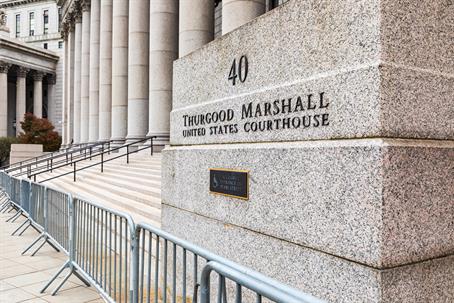
Kalshi v. New York: The Question Judge Torres Refused to Answer
Kalshi wants New York's gambling regulators to leave it alone. Its theory is that federal commodities law hands the CFTC exclusive jurisdiction over the event contracts it lists, so state gambling law has nothing to say about them. On July 7, Judge Analisa Torres of the Southern District of New York rejected that theory and refused to enjoin the New York State Gaming Commission (KalshiEX LLC v. Williams, No. 25 Civ. 8846 (AT) (S.D.N.Y. July 7, 2026)). As of early July, Kalshi has won some of these motions and lost others; the federal courts are split. One more loss, by itself, is not much of a story.
What happened inside the opinion is remarkable. Judge Torres assumed, without deciding, that Kalshi's sports-event contracts are "swaps" under the Commodity Exchange Act, and she ruled against Kalshi anyway. For a company whose entire argument depends on those contracts being federally regulated swaps, that should worry it more than the result did.
What Kalshi's case rests on
Kalshi's argument is clean. The CEA gives the CFTC exclusive jurisdiction over swaps traded on a designated contract market. Kalshi is such a market. Its contracts are swaps. So New York is preempted. Win the swap question, win the case.
Judge Torres would not fight on that ground. Following the Sixth Circuit in Schuler (KalshiEX LLC v. Schuler, No. 26-3196, 2026 WL 1295806, at *3 (6th Cir. Apr. 24, 2026)) and the District of Maryland in Martin (KalshiEX LLC v. Martin, 793 F. Supp. 3d 667 (D. Md. 2025)), she granted Kalshi the swap premise for free and asked a different question. Even if these are swaps, how far does the CFTC's exclusive jurisdiction reach into an area the states have always run? On that question, classification barely matters.
The distinction is not academic, because the swap question is not where these cases are diverging. In Arizona, the court decided that Kalshi's contracts are swaps and enjoined the state, reversing an earlier denial of preliminary relief (KalshiEX LLC v. Johnson, No. 26 Civ. 1715, 2026 WL 1223373, at *4-5 (D. Ariz. May 5, 2026); earlier denial at 2026 WL 958171 (D. Ariz. Apr. 8, 2026)).
Judge Torres assumed the same swap premise and reached the opposite result, because she read preemption differently. Both courts proceeded as though these were swaps and still split. Classification is the fight Kalshi's lawyers keep pressing; preemption scope is the fight the courts keep deciding. That is where this litigation really sits, and it is buried under every write-up that frames the whole dispute as a quarrel over whether an event contract is a swap.
The quiet center of the opinion
Once the question is scope rather than category, the opinion slows down and does the work the summaries skip. It is also the work that decides the case.
Preemption came in two forms here, and Kalshi needed one of them. Either Congress had occupied the whole field of derivatives regulation and left no room for the states (field preemption), or New York's law clashed with federal law so badly that a company could not obey both at once (conflict preemption). Torres worked through each and found neither.
Take field preemption first. She rejected it on three textual grounds.
The first is a savings clause sitting inside the very sentence Kalshi relies on. A savings clause is the language Congress adds to a statute to keep it from sweeping away law it did not mean to disturb. It "saves" that other law, holding it apart from the provision around it, and when a grant of authority carries one, Congress is signaling that the grant is meant to coexist with other law rather than replace it.
Here, that clause sits in the same provision as the power Kalshi is counting on. Section 2's grant of "exclusive jurisdiction" (7 U.S.C. § 2(a)(1)(A)) goes on to say that nothing in it may "supersede or limit" jurisdiction otherwise given to other federal or state authorities. Congress handed the CFTC exclusive jurisdiction and, in the next clause, promised not to displace anyone else's. A savings clause does not settle every preemption question; the Supreme Court has allowed conflict preemption to operate despite one (Geier v. American Honda Motor Co., 529 U.S. 861 (2000)), and the Third Circuit majority in Flaherty read this same statute as strongly preemptive. On the field-preemption question in front of Judge Torres, though, a power that arrives with its own disclaimer is not the language of a Congress claiming an entire field.
The second is the Special Rule that Dodd-Frank added in 2010 (7 U.S.C. § 7a-2(c)(5)(C)). It lets the CFTC block event contracts that are "contrary to the public interest," and it lists the categories that qualify, among them activity "unlawful under any Federal or State law" and "gaming." A statute that tells the agency to police contracts because they would break state law is an odd place to find state law erased.
The third ground is the strongest, and it is the one the coverage has largely passed over. Section 16 (7 U.S.C. § 16) shows what it looks like when Congress does preempt state gambling law. It does exactly that, but only in a few narrow situations involving specific electronic trading facilities and specific excluded or exempted agreements, none of which is in play here (§ 16(e)).
Section 16 also bars states from treating a swap as an insurance contract (§ 16(h)). When Congress means to displace state law, it says so by name. A Congress that preempted state gaming rules in a sentence or two in Section 16 did not silently wipe out the rest through the general jurisdictional grant in Section 2. Judge Torres calls that "strong evidence," a phrase she borrows from the Maryland court in Martin (Martin, 793 F. Supp. 3d at 681). It is the reasoning most likely to carry weight on appeal.
One principle runs beneath all three grounds, and the opinion relies on it without quite announcing it. Courts presume that Congress does not preempt in areas states have long governed, and gambling sits near the center of that tradition. A court in this district called its regulation a matter of "predominantly state concern" more than thirty years ago (Chun v. State of New York, 807 F. Supp. 288, 292 (S.D.N.Y. 1992)). The presumption does not decide the case by itself. It sets how high Kalshi had to reach, and it explains why every silence in the statute may read against the company instead of for it.
What self-certification does not buy
Field preemption failed. Conflict preemption is the other route, and it is where the opinion produces the two lines the prediction-market industry should least want to see travel.
First, self-certifying a contract is not the same as making it legal. A designated contract market may list a product by certifying that it complies with the law, but the certification does not decide whether it actually does. The CFTC keeps the power to find that a contract involving "gaming" is contrary to the public interest and pull it. Certification opens the door. It does not in all cases bless what walks through.
Second, and sharper, the agency's silence is not the agency's approval. Kalshi argued that because the CFTC could have pulled its sports contracts under the Special Rule and chose not to, New York was interfering with a federal decision. Judge Torres, quoting the Ohio district court in the same Schuler litigation, answered that the agency's inaction "is not proof that the sports-event contracts are regulated by or permissible under the CEA" (KalshiEX LLC v. Schuler, No. 25 Civ. 1165, 2026 WL 657004, at *9 (S.D. Ohio Mar. 9, 2026)). A veto left unused is not a ruling. That one move takes apart the industry's favorite defense, the one that goes "we self-certified, the CFTC let it ride, so we are fine."
Her handling of impossibility is better than the headline version too. Kalshi claimed that obeying New York would force it to break the CFTC's "impartial access" rule by walling off part of its own platform. Judge Torres read the rule for what it says. It forbids discriminatory access criteria. It does not require an exchange to offer every contract in every state. A national platform that obtains a New York license and treats its New York users alike has not violated impartial access. It has done what regulated businesses do, which is answer to two regulators at once (Martin, 793 F. Supp. 3d at 686). The Ohio court's verdict on Kalshi's contrary claim was short, and Torres adopts it: Kalshi offered "nothing but its own ipse dixit" (Schuler, 2026 WL 657004, at *9).
The footnote that unsettles it
One footnote lifts this opinion above the usual docket update. In it, Judge Torres notes that on June 10, 2026, the CFTC issued a proposed rule (Release No. 9249-26) on the very Special Rule her decision leans on: the provision that lets the agency police event contracts tied to certain listed activities, "gaming" among them.
She notes it and moves on, but the consequence is bigger than a footnote. Every court that has ruled against Kalshi has leaned on those listed activities, "gaming" foremost among them, as proof that Congress wanted state gambling law to keep working inside the federal scheme. That is the beam holding up the whole anti-preemption argument. And the CFTC is now proposing to define or narrow those very terms by rule. The courts, in other words, are construing a provision the agency is reworking as they read it.
Which way the rulemaking cuts is an open question, and a consequential one. A rule that federalizes how "gaming" contracts are handled could help Kalshi, supplying the single national standard the courts have so far found missing. A rule that leans into the public-interest test, and keeps a role for state judgments about what counts as unlawful gaming, would strengthen the reasoning Judge Torres just used against it. Either way, the ground under this line of cases is still shifting. Judge Torres was careful enough to say so, even as she rested her decision on it.
What to watch
Kalshi appealed to the Second Circuit the same day. Judge Torres did not follow the Third Circuit's majority in Flaherty (KalshiEX LLC v. Flaherty, 172 F.4th 220 (3d Cir. 2026)). She lined up with the courts that have denied Kalshi and drew on Judge Roth's dissent in that case (id. at 234, 240 (Roth, J., dissenting)), including its reading of the legislative history and Senator Blanche Lincoln's warning that the Special Rule was written to stop the very contracts, built around the Super Bowl, the Kentucky Derby, and the Masters, that would "be used solely for gambling" (156 Cong. Rec. S5906-07 (2010)). If the Second Circuit affirms, the split with the Third Circuit is clean and squarely presented, which is how a question like this reaches the Supreme Court.
That is the appeal to watch. The line to keep from this opinion is the conditional one. Assume these are swaps, Judge Torres wrote, and New York can still regulate them. Kalshi has spent a year litigating whether they are swaps. The courts have decided that answering the question does not save the contracts.