
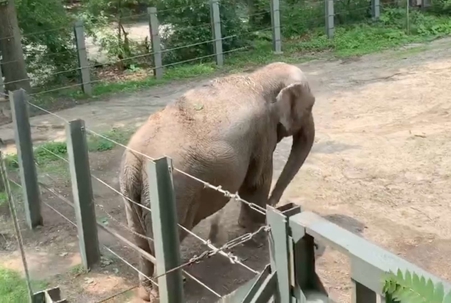
On the Passing of Happy the Elephant, and the Conscience of the Law
A statement from De Silva Law Offices, LLC
In 2021, this firm appeared before the Court of Appeals of the State of New York on behalf of three Buddhist scholars as amici curiae in Matter of Nonhuman Rights Project, Inc. v. Breheny, the case of Happy, an Asian elephant confined at the Bronx Zoo. On May 28, 2026, Happy was euthanized in a barn at that zoo. She had been held there since 1977, and for roughly the last twenty years of her life she was kept alone, in solitary confinement, after the deaths of the companions with whom she had once shared an enclosure.
Happy was, by the account of the scientists who studied her, the first elephant ever shown to recognize herself in a mirror. She knew her own reflection. The law proved less perceptive.
We are deeply saddened by her death. It is the kind of loss that ought to trouble anyone who believes the law must answer to conscience as well as to precedent.
The question Happy's case put to the courts was narrow in form and profound in substance: whether she was the kind of being who could ask, through the ancient writ of habeas corpus, that a court require her captor to justify her confinement. By the narrowest of margins, the Court of Appeals said she was not. The implication deserves to be stated plainly. Our law already extends legal personhood to entities that are neither human nor even alive: corporations sue, are sued, hold property, and assert rights in their own name, and a growing number of jurisdictions around the world have recognized rivers as legal persons bearing rights of their own. Yet a demonstrably self-aware elephant, capable of suffering, was placed outside that circle altogether.
Two judges dissented, and dissented powerfully:Judge Rowan Wilson, now the Chief Judge of New York, and Judge Jenny Rivera. Judge Wilson observed that the rights we extend to others are, in the end, a measure of who we are as a society. The trial court, even while constrained by precedent, had already acknowledged that Happy was no mere article of property, but an intelligent, autonomous being who might be entitled to liberty.
As the attorney who submitted our brief, I am compelled to state plainly that I remain deeply disappointed in the New York Court of Appeals. The Court did not find that Happy was incapable of suffering, or that her captivity served any purpose beyond the commercial and the customary. It found, in effect, that her suffering was beyond the reach of the law, that the door of personhood was one it would not open. That was a failure not of evidence, but of will.
We believe a day will come when the confinement of beings like Happy, animals of demonstrated intelligence, deep social attachment, and evident capacity for grief and joy, will be regarded as we now regard practices that earlier generations thought ordinary and defended as humane. It will be seen for what it is: an archaic cruelty. The history of law is in large part a history of moral certainties surrendered slowly and reluctantly, of suffering the law was once content to ignore and later ashamed to have ignored. The expansion of who counts, across lines of race, of sex, of station, has never come easily, and it has rarely come from the law leading. More often it has come from the law being shamed into catching up.
The brief we filed pressed this very point, drawn from a tradition twenty-five centuries old. Our clients, scholars of Buddhist ethics, argued that Happy is a sentient being, no different in her essential nature from any human being in her capacity to suffer, and therefore owed compassion rather than a cage. Buddhism recognizes no hierarchy of species that would permit us to prize our own freedom while remaining indifferent to the imprisonment of another sentient life. We wrote then that the consideration of morals is a necessary check upon the law, precisely because morals have so often been right where the law has been wrong. Happy's life, and now her death, have proved that argument in the only way that finally persuades. She never adapted to the cage. She suffered in it for nearly half a century, and she died in it.
This is not the end of the matter. One elephant, Patty, remains at the Bronx Zoo, and the Wildlife Conservation Society long ago pledged to close its elephant exhibit once only a single elephant was left. That day has arrived, and the Society should honor its word. And the question Happy's case raised, whether the law will recognize the liberty of an autonomous nonhuman being, is now before other courts, including the highest court in California. This firm intends to remain engaged in that work.
Happy opened a courtroom door that cannot now be closed. We grieve that it was not opened in time to free her. We are determined that it be opened for those who remain.
De Silva Law Offices, LLC filed an amici curiae brief on behalf of Buddhist scholars in Matter of Nonhuman Rights Project, Inc. v. Breheny, Court of Appeals of the State of New York, APL 2021-00087. The brief is available here.